
A guide to car mobility aids for the elderly and disabled: swivel cushions, transfer handles, leg lifters, grants in Ireland, and safe transfer technique.
Getting in and out of a car becomes harder after a hip or knee replacement, with arthritis, or simply with age. Car mobility aids are small, low-cost tools that make each transfer safer and less painful, without needing any permanent change to the vehicle. This guide covers the main types available, who each one suits, safe technique, and the financial supports available to drivers and passengers with a disability in Ireland.
What Counts as a Car Mobility Aid
A car mobility aid is any product designed to make entering, exiting, or repositioning inside a car easier. Most fall into one of two groups. The first is a portable aid that travels with the person and works in almost any car: a swivel cushion, a transfer handle, a leg lifter. The second is a fitted adaptation, such as a rotating seat base or a wheelchair hoist, which is installed into a specific vehicle by an approved adaptation company.
Portable aids are the right starting point for most people. They cost far less, need no vehicle modification, and can be swapped between cars, taxis, or a partner’s vehicle. Fitted adaptations become worthwhile once a person is a full-time wheelchair user or has very limited leg and trunk strength.
Aids for Getting In and Out of a Car
These are the aids most people search for first, usually after a specific query like “how do I get in and out of a car without pain” rather than a diagnosis.
Swivel Cushions
A swivel cushion sits on the car seat and rotates 360 degrees, so the legs can swing in and out without twisting the hips, knees, or spine. It suits people recovering from hip or knee surgery, those with lower back pain, and anyone who finds the sideways pivot into a seat the hardest part of the journey. Occupational therapy guidance from LiveUp, an Australian ageing-well service, notes that a swivel cushion is particularly useful for people who lack flexibility or strength, or who experience pain or fatigue during the transfer.1
Transfer Handles (Handybar-Style Aids)
A transfer handle, often known by the brand name Handybar, slots into the U-shaped striker plate in the car door frame and provides a raised, sturdy grip to pull up on. It works on most saloons, hatchbacks, and SUVs, and needs no tools to fit. It suits people who have some standing strength but need a firm point of leverage, rather than the door frame or a wet armrest, to push or pull against.
Leg Lifters
A leg lifter is a strap with a rigid handle or loop, used to lift a leg into the footwell when hip or knee movement is limited. It removes the need to reach down and physically hoist the leg by hand, which is often the step that causes strain or loss of balance after joint surgery.
Transfer Boards
A transfer board bridges the gap between a wheelchair and the car seat, allowing a person to slide across rather than stand and pivot. It requires either good upper body strength or help from a carer, and is most commonly used for people with spinal cord injuries or very limited leg function.
Car Mobility Aids for the Elderly
Search behaviour shows a clear split between “car aids for elderly” and general disability terms, and the products often overlap, but the priorities differ. For an older adult without a formal diagnosis, the goal is usually to prevent a fall or a sudden loss of balance during the transfer, not to accommodate a fixed physical limitation.
A swivel cushion combined with a transfer handle covers most of these cases. The cushion reduces the twisting strain that causes hip and knee pain, and the handle gives a secure point of contact so the person is never relying on balance alone. Both aids pack away in a bag or door pocket and travel with the person rather than the car, which matters for someone who is a passenger in different vehicles, such as a family member’s car, a taxi, or a hospital transport service.
NHS post-surgical guidance describes a similar step-by-step method for getting into and out of a car after an operation: park away from kerbs or raised surfaces, recline the seat back slightly, back up to the seat with the walking aid facing away from the car, then lower down in a controlled movement.2 The same principles apply whether the surgery was recent or the difficulty has built up gradually with age.
Car Mobility Aids for Disabled Drivers and Passengers
For a driver or passenger with a permanent physical disability, car mobility aids tend to be part of a wider setup rather than a single product. Common additions include:
- Grab handles or rails fitted to the door frame or roof for a stronger, permanent hold point
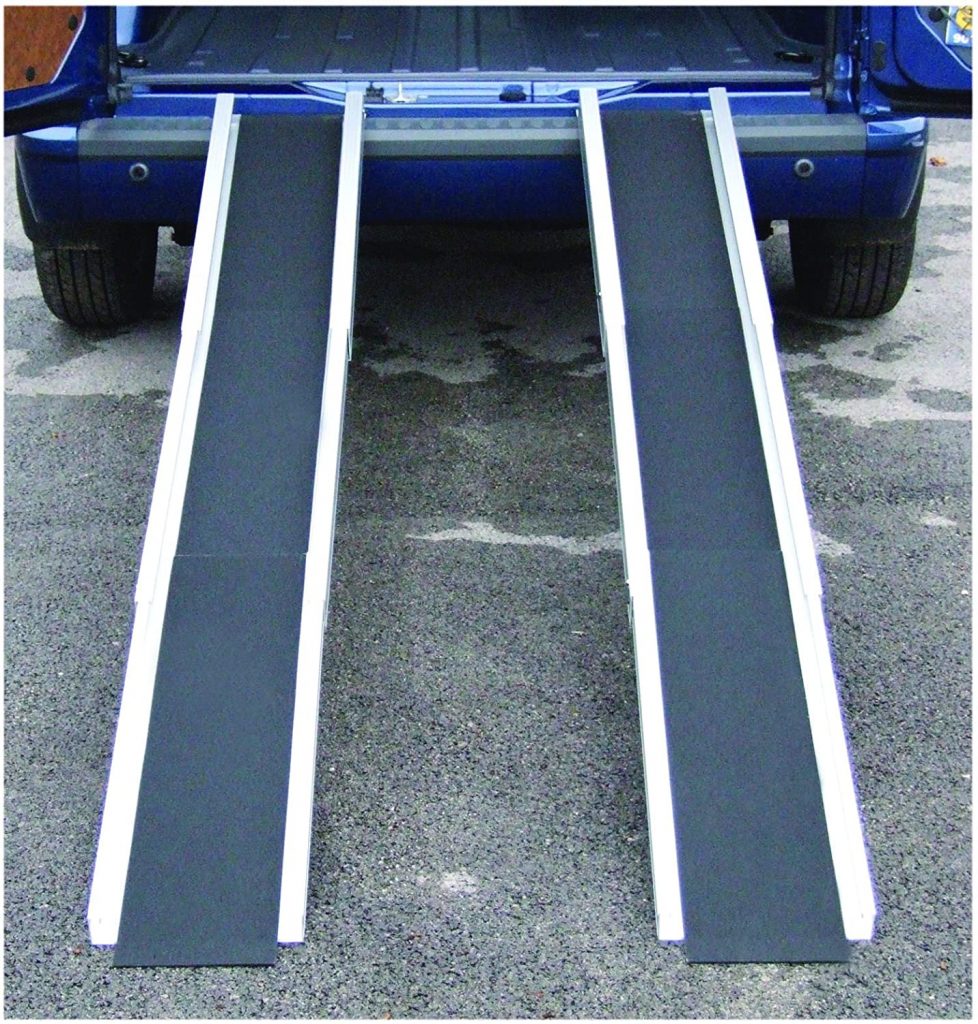
- Portable folding ramps for loading a wheelchair or scooter into the boot
- Swing-out or rotating car seats, fitted by an approved adaptation company, for someone who cannot pivot at all
- Hoists for lifting a wheelchair into the boot or roof box without manual handling
The Irish Wheelchair Association provides advice on car adaptations and can point drivers and passengers toward NSAI-approved adaptation companies who install this kind of equipment.3 An occupational therapist assessment is worth arranging before buying fitted equipment, since the right choice depends on trunk control, arm strength, and the specific car being adapted.
How to Get In and Out of a Car Safely
Whatever aid is used, the underlying technique stays the same:
- Park on level ground where possible, away from kerbs or slopes.
- Open the door as wide as it goes and, if the seat reclines, tilt it back slightly for more headroom.
- Back up to the seat until the back of the legs touch the edge of it.
- Reach back for the seat or dashboard, not the door, and lower down slowly rather than dropping into place.
- Once seated, lift the legs in one at a time, using a leg lifter if needed, rather than twisting the whole body.
- To get out, reverse the process: swing the legs out first, then push up using the seat or dashboard.
Rushing is the most common cause of a fall during a car transfer. Taking a few extra seconds at each stage matters more than the specific aid being used.
Financial Support for Car Mobility Aids in Ireland
Portable aids like swivel cushions and transfer handles are not covered by any State scheme and are bought directly. Fitted adaptations are a different matter. The Disabled Drivers and Disabled Passengers Scheme, administered by Revenue, provides relief on VRT and VAT for vehicles that are specially constructed or adapted for a driver or passenger who holds a Primary Medical Certificate, along with an exemption from motor tax and an annual fuel grant.4
A Primary Medical Certificate is assessed through the HSE, not by a GP, and is a separate process from the Disabled Person’s Parking Card. Anyone considering vehicle adaptations should apply for the certificate before purchasing a vehicle, since the relief only applies to specially constructed or adapted vehicles bought under the scheme.
Fitness to Drive Considerations
A car mobility aid solves the physical problem of getting in and out of the car. It is separate from the legal question of whether a person is fit to drive with a given medical condition. The Road Safety Authority, together with the National Office for Traffic Medicine, publishes the Sláinte agus Tiomáint guidelines, which set out when a medical report is required and how conditions affecting movement, strength, or reaction time should be reviewed.5 Anyone with a new diagnosis or a recent surgery that affects mobility should check with their GP whether it needs to be reported, separately from any decision about mobility equipment.
Choosing the Right Car Mobility Aid
A few questions narrow down the choice quickly:
- Is the difficulty with twisting and pivoting, or with strength and balance? Twisting points toward a swivel cushion; balance points toward a transfer handle.
- Will the aid be used in one car or several? A portable aid travels; a fitted adaptation does not.
- Is the person a driver or a passenger? Drivers need aids that don’t interfere with reaching the pedals or wheel once seated.
- Is this a temporary recovery, such as after surgery, or a permanent condition? Temporary needs rarely justify a fitted adaptation.
Frequently Asked Questions
Can I use a swivel cushion and a transfer handle at the same time?
Yes. They solve different parts of the transfer and are commonly used together: the handle for the pull up or down, the cushion for the leg swing.
Do transfer handles fit every car?
Most fit the standard U-shaped striker plate found in the door frame of most saloons, hatchbacks, and SUVs. Some very old or unusual door mechanisms don’t have a compatible striker, so it’s worth checking the door frame shape before buying.
Is a Primary Medical Certificate needed to buy a swivel cushion or transfer handle?
No. These are sold as ordinary consumer products. A Primary Medical Certificate is only relevant to the Revenue tax relief scheme for adapted vehicles, not to portable aids.
What is the difference between a swivel cushion and a rotating car seat?
A swivel cushion is a portable disc placed on top of the existing seat. A rotating car seat is a fitted adaptation where the entire seat base swings outward from the car, installed by an approved adaptation company. The seat is a bigger commitment in cost and fitting, but suits someone who cannot pivot on a cushion at all.
Will my car insurance be affected by fitting mobility equipment?
Portable aids that aren’t fixed to the car don’t need to be declared. Fitted adaptations, such as hand controls or a rotating seat, should be reported to the insurer, since they change the vehicle from its original specification.
Sources: LiveUp Assistive Products;1 Oxford University Hospitals NHS Foundation Trust;2 Irish Wheelchair Association;3 Revenue Commissioners;4 Road Safety Authority.5