
Find the right knee scooter for foot and ankle injuries. Stable, comfortable knee walkers with expert advice and fast delivery throughout Ireland.
Knee Scooters Ireland – The Complete Guide to Choosing the Right Knee Walker
If you’ve injured your foot, ankle or lower leg, being told to stay off your foot for several weeks can feel overwhelming. Everyday tasks such as making a cup of tea, shopping, walking the dog or collecting the children from school suddenly become much more difficult.

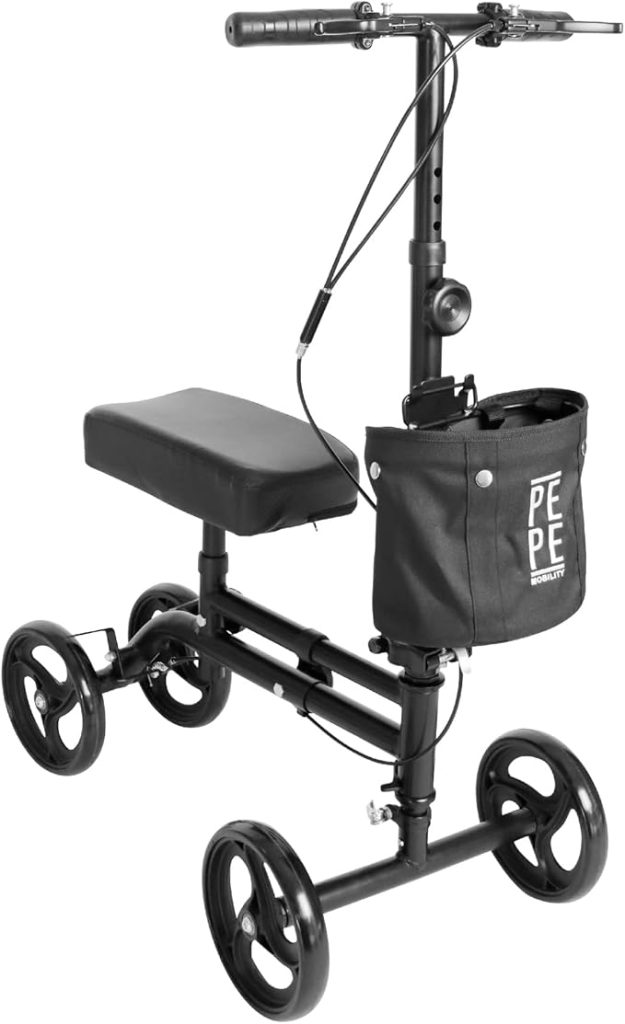
PEPE Mobility Knee Scooter for Foot Injuries Adult, Indoor Walker, Disability Aids for Broken Ankle

While crutches have traditionally been the standard mobility aid during recovery, many people now discover that a knee scooter, sometimes called a knee walker, offers a far more comfortable, practical and stable way to stay mobile.
At Mobility Aids Ireland, we’ve helped thousands of customers find mobility solutions that make everyday life easier. Whether you’re recovering from surgery, managing a fracture, healing from ligament damage or following medical advice to remain non-weight bearing, choosing the right knee scooter can help you regain confidence and independence throughout your recovery.
This comprehensive guide explains everything you need to know before buying a knee scooter in Ireland. We’ll explain how they work, who they’re suitable for, how they compare with crutches, the features worth considering and how to choose the right model for your needs.
Table of Contents
What Is a Knee Scooter?
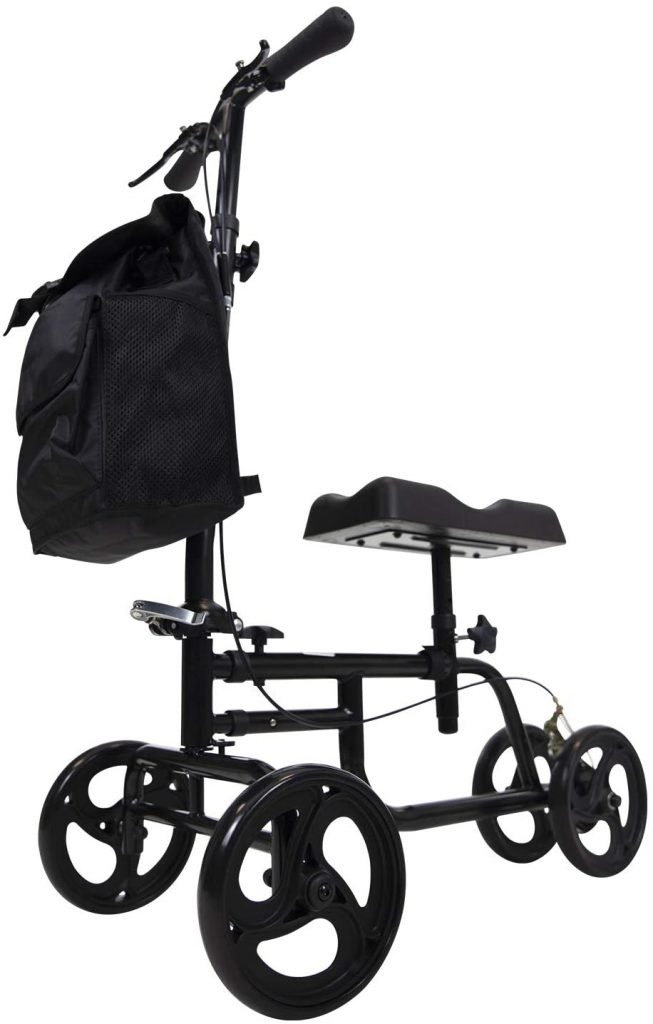
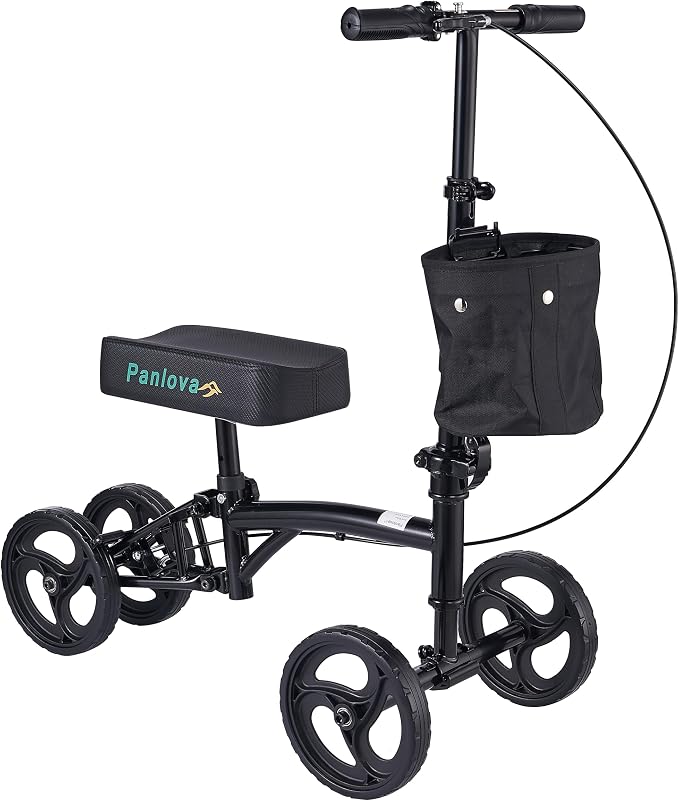
A knee scooter is a wheeled mobility aid designed for people who cannot place weight on one foot or lower leg. Instead of hopping on one leg using crutches, you rest your injured leg comfortably on a padded knee platform while using your healthy leg to propel yourself forwards.
The handlebars provide steering and balance, while hand-operated brakes allow you to slow down and stop safely. Most modern knee walkers also include adjustable handlebars and knee platforms so they can be tailored to different users.
Unlike a traditional mobility scooter, a knee scooter has no motor. It is powered entirely by the user and is intended specifically for temporary recovery from lower limb injuries.
Common names include:
- Knee scooter
- Knee walker
- Leg scooter
- Broken foot scooter
- Scooter for broken ankle
- Orthopaedic knee walker
Although the names vary, they all describe the same type of mobility aid.
Why Are Knee Scooters Becoming So Popular?
Healthcare professionals increasingly recommend knee scooters because they offer greater comfort and freedom than traditional crutches for many patients. While crutches remain appropriate in certain situations, prolonged use can become tiring and physically demanding.

Many users are surprised at just how much energy is required to move around on crutches. Supporting your entire body weight through your hands, wrists and shoulders for several weeks can quickly lead to fatigue, muscle soreness and reduced confidence.
By comparison, a knee walker allows your injured leg to remain supported while your healthy leg performs a natural walking motion. Many users find this smoother, faster and considerably less exhausting.
Some of the biggest advantages include:
- Reduced strain on wrists, shoulders and arms.
- Improved stability on flat surfaces.
- Greater confidence when moving indoors.
- More natural movement than hopping on crutches.
- Comfortable padded knee support.
- Easy steering with bicycle-style handlebars.
- Simple hand-operated braking.
- Useful storage baskets on many models.
For many people, the difference can be life-changing during a six to twelve week recovery period.
Who Can Benefit From a Knee Scooter?
Knee scooters are designed for people who need to avoid placing weight on one foot or lower leg but who still have sufficient balance, coordination and strength in their unaffected leg.
They are commonly used during recovery from:
- Broken ankles
- Broken feet
- Metatarsal fractures
- Achilles tendon surgery
- Foot reconstruction surgery
- Bunion surgery
- Plantar fascia surgery
- Ligament repairs
- Toe surgery
- Soft tissue injuries
- Sports injuries
- Lower leg fractures
Many orthopaedic surgeons recommend knee walkers following procedures where patients must remain completely non-weight bearing for several weeks.
Instead of spending much of that time confined indoors, users often find they can continue many everyday activities with greater independence.
Knee Scooter vs Crutches – Which Is Better?
This is one of the most common questions people ask after suffering a foot or ankle injury.
The answer depends on your injury, your mobility and your doctor’s advice. However, for many non-weight bearing injuries, a knee scooter offers several important advantages over traditional crutches.
| Feature | Knee Scooter | Crutches |
|---|---|---|
| Weight carried through arms | Very little | High |
| Comfort during long periods | Excellent | Can become tiring |
| Indoor mobility | Very good | Good |
| Outdoor pavements | Very good | Good |
| Speed of movement | Usually faster | Slower |
| Carrying shopping | Easier with basket | Difficult |
| Learning curve | Short | Can take practice |
| Stairs | Not suitable | Usually preferred |
One important point is that knee scooters are not necessarily a complete replacement for crutches. Many people use both during recovery, using the scooter for everyday movement around the home, workplace or shopping centre while relying on crutches when navigating stairs or particularly confined spaces.
How Does a Knee Walker Work?
The principle behind a knee scooter is surprisingly simple.
Your injured leg rests on a padded platform, keeping your foot elevated and completely clear of the ground. Your unaffected leg provides the power, pushing the scooter forwards using a natural walking movement.
The handlebars allow precise steering, while the braking system provides control whenever you need to stop.
Most people become comfortable using a knee scooter within just a few minutes.
Modern designs include:
- Height-adjustable handlebars.
- Height-adjustable knee platform.
- Comfortable padded knee cushion.
- Front steering wheels.
- Reliable hand brakes.
- Parking brake.
- Folding frame for transport and storage.
Because there is no electric motor, maintenance requirements are minimal.
Everyday Activities Become Easier
One of the biggest frustrations during recovery is losing independence.
Simple activities suddenly require planning, assistance or considerable effort.
Many users report that switching from crutches to a knee scooter makes everyday life significantly more manageable.
Examples include:
- Preparing meals.
- Shopping.
- Working in an office.
- Moving around warehouses.
- School runs.
- Walking around hospitals.
- Attending appointments.
- Moving around shopping centres.
- Visiting friends and family.
Many models also include a front basket, allowing you to carry drinks, shopping, medication or personal belongings without needing someone else to help.
Are Knee Scooters Suitable for Older Adults?
Age alone should not determine whether someone uses a knee scooter.
What matters most is balance, confidence and the ability to safely propel the scooter using the unaffected leg.
Many older adults find knee scooters easier than crutches because they reduce pressure on the shoulders, wrists and hands. This can be particularly beneficial for people who also experience arthritis or reduced upper body strength.
Before using any mobility aid, it is important to follow the advice of your healthcare professional, particularly after surgery or following complex fractures.
Can You Use a Knee Scooter Outside?
Yes—many modern knee scooters are designed for both indoor and outdoor use.
Large wheels, quality bearings and robust frames allow users to travel comfortably on pavements, footpaths, shopping centres and smooth outdoor surfaces.
However, terrain still matters. Gravel, deep grass, muddy paths, loose stones and uneven ground require greater care than smooth pavements or indoor flooring.
If you expect to spend significant time outdoors, choosing a model with larger wheels and excellent braking performance is particularly worthwhile.
How to Choose the Right Knee Scooter
At first glance, many knee scooters appear similar. However, there are significant differences in stability, comfort, manoeuvrability and long-term usability. Choosing the right model depends on your height, weight, where you intend to use it and the length of your recovery.
While almost any knee walker is likely to be more comfortable than relying solely on crutches, selecting a model with the right features can make several weeks of rehabilitation considerably easier.
Before making your choice, consider the following factors.
1. Will You Mainly Use It Indoors or Outdoors?
This is often the most important question.
If your knee scooter will mainly be used around the house, office or shopping centres, a compact model with excellent steering is usually the best option. Narrower scooters can pass through standard internal doorways more easily and turn comfortably in kitchens, bathrooms and hallways.
If you expect to use your scooter outdoors every day, larger wheels generally provide a smoother ride over paving joints, dropped kerbs and uneven pavements.
Many Irish customers use their scooter for:
- Walking to nearby shops.
- Collecting children from school.
- Travelling around supermarkets.
- Hospital appointments.
- Office work.
- Garden paths.
- Shopping centres.
- Medical clinics.
Thinking about where you’ll spend most of your recovery helps narrow your options considerably.
2. Four Wheels Offer the Best Stability
Most modern knee scooters use a four-wheel design.
The reason is simple—four wheels provide excellent balance while allowing smooth steering and predictable handling.
For the majority of users recovering from foot or ankle injuries, a four-wheel scooter offers the ideal combination of stability and manoeuvrability.
Benefits include:
- Excellent balance when stationary.
- Smooth steering.
- Greater confidence for first-time users.
- Stable braking.
- Suitable for both indoor and outdoor surfaces.
Unless your healthcare professional recommends otherwise, a quality four-wheel knee scooter will suit most recovery situations.
3. Adjustable Handlebars Make a Big Difference
No two users are exactly the same height.
One of the first things you should check is whether both the handlebars and knee platform can be adjusted independently.
Correct adjustment allows:
- A comfortable upright posture.
- Reduced shoulder strain.
- Better steering control.
- Improved braking confidence.
- Less fatigue during longer journeys.
Using handlebars that are too low often causes users to lean forwards unnecessarily, while handlebars that are too high can reduce steering control.
4. Knee Pad Comfort Matters More Than Many People Realise
Your injured leg may spend several hours each day resting on the knee platform.
A generously padded knee cushion distributes pressure evenly and helps improve comfort throughout longer periods of use.
Premium models often feature thicker cushioning combined with a wider support platform, helping reduce pressure on the knee during extended journeys around shops, hospitals or workplaces.
5. Brakes Should Feel Positive and Easy to Use
Every quality knee scooter should have reliable hand-operated brakes.
These work in much the same way as bicycle brakes, allowing gradual slowing before coming to a complete stop.
Many models also include a parking brake.
This locks the scooter in position while you:
- Prepare food.
- Stand from a chair.
- Transfer to a sofa.
- Use a workbench.
- Queue in shops.
A parking brake may seem like a small feature, but many users quickly discover how useful it becomes during day-to-day recovery.
6. Folding Frames Make Storage Much Easier
One feature many buyers overlook is whether the scooter folds.
A folding frame makes it easier to:
- Transport in a car boot.
- Store when not in use.
- Take on holiday.
- Bring to hospital appointments.
- Move between rooms.
For temporary injuries lasting several weeks, convenient storage can be just as important as comfort.
Pneumatic Tyres or Solid Wheels?
Some premium knee scooters are fitted with pneumatic (air-filled) tyres, while others use solid rubber wheels.
Neither option is universally better—the right choice depends on where you’ll use the scooter.
| Solid Wheels | Pneumatic Tyres |
|---|---|
| Minimal maintenance | Smoother ride outdoors |
| Cannot puncture | Better shock absorption |
| Excellent indoors | Comfortable on rougher paths |
| Lower maintenance | May require occasional inflation |
For most people recovering at home and using pavements or shopping centres, either option performs very well.
Weight Capacity Is an Important Safety Consideration
Every knee scooter is designed to support a maximum user weight.
Choosing a model that comfortably accommodates your weight helps ensure safe handling and reliable performance throughout your recovery.
Heavy-duty models are available for users requiring higher weight capacities, often featuring reinforced frames and larger wheels.
Always check the manufacturer’s specifications before purchasing.
Can You Use a Knee Scooter After Foot Surgery?
Yes—this is one of the most common reasons people purchase a knee walker.
Following surgery, many patients are instructed to avoid putting any weight through the affected foot for several weeks.
Depending on your consultant’s advice, a knee scooter may help during recovery from:
- Bunion correction surgery.
- Achilles tendon repair.
- Foot fusion surgery.
- Reconstructive procedures.
- Toe surgery.
- Ligament repair.
- Plantar fascia surgery.
Always follow your surgeon’s specific rehabilitation instructions regarding weight-bearing and mobility.
Can a Knee Scooter Be Used with a Cast or Walking Boot?
In many cases, yes.
Knee scooters are frequently used by people wearing:
- Fibreglass casts.
- Plaster casts.
- Protective walking boots.
- Orthopaedic braces.
Because your injured leg rests on the padded support rather than the foot itself, the cast or boot remains elevated and protected while moving around.
If you’re unsure whether a knee scooter is suitable with your particular cast or brace, consult your orthopaedic team before use.
When a Knee Scooter May Not Be Suitable
Although knee scooters are an excellent mobility aid for many people, they are not appropriate in every situation.
They may be unsuitable if you:
- Have injuries affecting both legs.
- Have significant balance problems.
- Need to negotiate multiple flights of stairs every day.
- Have certain neurological conditions affecting coordination.
- Cannot safely support yourself on your unaffected leg.
Your doctor, physiotherapist or orthopaedic consultant will advise whether a knee walker is appropriate for your individual circumstances.
Common Mistakes People Make When Buying a Knee Scooter
Many buyers are purchasing a knee scooter for the first time and understandably focus mainly on price. However, a few simple considerations can make a significant difference to comfort over several weeks of recovery.
Some of the most common mistakes include:
- Choosing a model without adjustable handlebars.
- Ignoring the maximum user weight.
- Buying purely on appearance.
- Forgetting to measure storage space.
- Not considering whether the scooter will fit into the car.
- Choosing a model designed mainly for indoor use when outdoor use is expected.
- Not checking whether replacement parts are available.
Investing a little time in choosing the right model usually leads to a much more comfortable recovery experience.
Using a Knee Scooter Safely
A knee scooter is designed to improve mobility during recovery, but like any mobility aid it should be used correctly. Taking a few simple precautions can help you move around with greater confidence while reducing the risk of accidents.
Before using your knee walker for the first time, adjust both the handlebars and knee platform so that you can stand naturally without stretching or leaning excessively. Your injured leg should rest comfortably on the knee pad while your healthy leg remains slightly bent, allowing a smooth walking motion.
As you become familiar with the scooter, remember to:
- Start slowly until you are confident steering and braking.
- Always use both hands on the handlebars.
- Look ahead rather than down at the front wheels.
- Reduce speed before turning corners.
- Apply the brakes gradually rather than suddenly.
- Avoid wet leaves, loose gravel and slippery surfaces where possible.
- Use the parking brake whenever transferring to a chair or standing still.
- Wear supportive footwear on your unaffected foot.
Most people become comfortable using a knee scooter within a short period, but there is no need to rush. Confidence develops naturally with regular use.
Can You Use a Knee Scooter at Work?
For many people, recovering from a foot or ankle injury does not necessarily mean taking several weeks away from work. Depending on your occupation and your employer’s policies, a knee scooter may help you remain mobile in the workplace while following your consultant’s instructions not to bear weight on your injured foot.
Office environments are particularly well suited to knee walkers thanks to their smooth flooring, wide corridors and relatively level surfaces. Many users also find them useful in:
- Retail premises.
- Warehouses with smooth concrete floors.
- Schools and colleges.
- Hospitals and healthcare facilities.
- Reception areas.
- Factories with suitable walkways.
If you intend to use a knee scooter at work, speak to your employer beforehand so that any necessary adjustments can be made, such as ensuring clear walkways or providing a suitable place to store the scooter when not in use.
Travelling with a Knee Scooter
A lower leg injury doesn’t always mean cancelling every plan. Many people continue to travel during their recovery, whether that’s attending family events, visiting friends or taking a pre-booked holiday.
A folding knee scooter is particularly useful for transport as it can often be placed in the boot of a car once the handlebars are folded down. If travelling by public transport, it’s worth checking accessibility arrangements in advance, especially during busy periods.
If you are flying, contact your airline before travelling to confirm their procedures for mobility aids. Airlines have different policies regarding the carriage of mobility equipment, and advance notification usually makes the process much smoother.
Remember that a knee scooter is intended to assist your mobility at your destination. You should always follow airline, airport and healthcare guidance regarding your specific injury.
Looking After Your Knee Scooter
A quality knee scooter requires very little maintenance, but a few routine checks can help keep it operating smoothly throughout your recovery.
It’s good practice to:
- Check that all adjustment knobs remain securely tightened.
- Inspect the brakes regularly.
- Ensure wheels rotate freely.
- Remove mud or debris after outdoor use.
- Keep moving parts clean.
- Store the scooter somewhere dry when not in use.
If your model has pneumatic tyres, check the tyre pressure occasionally to maintain a comfortable ride.
Accessories That Can Make Recovery Easier
Many knee scooters can be fitted with practical accessories that improve convenience during everyday use.
Depending on the model, available accessories may include:
- Removable storage baskets.
- Drink holders.
- Additional storage bags.
- Replacement knee cushions.
- Replacement brake cables.
- Replacement wheels.
A front basket is one of the most popular additions, allowing you to carry shopping, medication, mobile phones, books or drinks without needing to balance them while moving.
PEPE Mobility Knee Scooter for Foot Injuries Adult, Indoor Walker, Disability Aids for Broken Ankle
Frequently Asked Questions About Knee Scooters
Do I need a prescription to buy a knee scooter?
No. Knee scooters are available to purchase without a prescription. However, if your consultant, physiotherapist or healthcare professional has recommended one, you should follow their advice regarding the most suitable type for your recovery.
Can I use a knee scooter after breaking my ankle?
Yes. Broken ankles are one of the most common reasons people use knee walkers. They allow your injured foot to remain off the ground while helping you stay mobile during recovery.
Can I use a knee scooter after breaking my foot?
Yes. Knee scooters are specifically designed for people recovering from foot injuries that require a period of non-weight bearing.
Are knee scooters easy to learn?
Most users become confident after only a short period of practice. The steering is intuitive, and the braking system operates in a similar way to bicycle brakes.
Will a knee scooter fit through normal doors?
Most models are designed with standard domestic doorways in mind. If your home has unusually narrow doorways, check the product dimensions before ordering.
Can I carry shopping on a knee scooter?
Many models include a front basket, making it much easier to carry everyday items than when using crutches.
Can I use a knee scooter on carpets?
Yes. Most knee scooters perform well on low-pile carpets, laminate flooring, tiles and wooden floors. Deep or thick carpets may require a little more effort.
Can I use one on hills?
Gentle slopes are generally manageable, but extra care should always be taken. Keep your speed under control and use the brakes as necessary.
How long do people usually need a knee scooter?
This varies depending on the injury. Some people use a knee walker for only a couple of weeks, while others recovering from more complex surgery may benefit from one for several months.
Why Buy Your Knee Scooter from Mobility Aids Ireland?
When recovering from an injury, you want equipment that is dependable, comfortable and delivered without unnecessary delays. At Mobility Aids Ireland, we understand that choosing the right mobility aid can make a significant difference to your recovery and your independence.
We carefully select knee scooters that are designed to provide stability, comfort and ease of use, while offering competitive prices and fast delivery throughout Ireland.
Whether you’re recovering from surgery, a sporting injury or an unexpected accident, our range has been chosen to help you stay mobile while protecting your recovery.
Find the Right Knee Scooter for Your Recovery
No one plans for a broken foot or ankle injury, but choosing the right mobility aid can make the weeks that follow considerably easier.
A quality knee scooter offers many people greater comfort, improved independence and a more practical alternative to relying solely on crutches. From moving around your home to returning to work or attending medical appointments, the right knee walker can help you continue everyday life while following your healthcare professional’s advice.
Browse our carefully selected range of knee scooters to compare features, specifications and designs. Whether you need a compact model for indoor use, a robust scooter for regular outdoor journeys or a folding design that’s easy to transport, you’ll find reliable options to support every stage of your recovery.
Investing in the right knee scooter today could make every day of your rehabilitation safer, more comfortable and far less restrictive.