
Shower seats for the elderly and disabled in Ireland, from €25. Chairs, stools, wall-mounted seats, bath seats and transfer benches compared.

Shower Seats
Why Shower Seating Matters
Table of Contents
Standing on a wet surface while washing, reaching down to the taps, or twisting to rinse are exactly the movements most likely to cause a fall.
The bathroom is consistently one of the highest-risk rooms in the home for older adults, partly because the floor is wet and partly because there’s little to hold onto once you’re inside the shower itself. Sitting down removes the balance demand almost entirely: no weight shifting from foot to foot, no standing on one leg to wash the other, and a lower centre of gravity if a slip does happen.
Shower seating isn’t only for people who can’t stand at all. It’s just as useful for anyone who tires partway through washing, anyone recovering from surgery or a hospital stay, and anyone who’s simply had a near-miss and wants to feel steadier going forward.
Shower Stool, Shower Chair, Wall-Mounted Seat, Bath Seat or Transfer Bench
Five different products get searched for under overlapping terms. They solve different problems, and picking the wrong one for the space is the most common buying mistake.
Shower stool
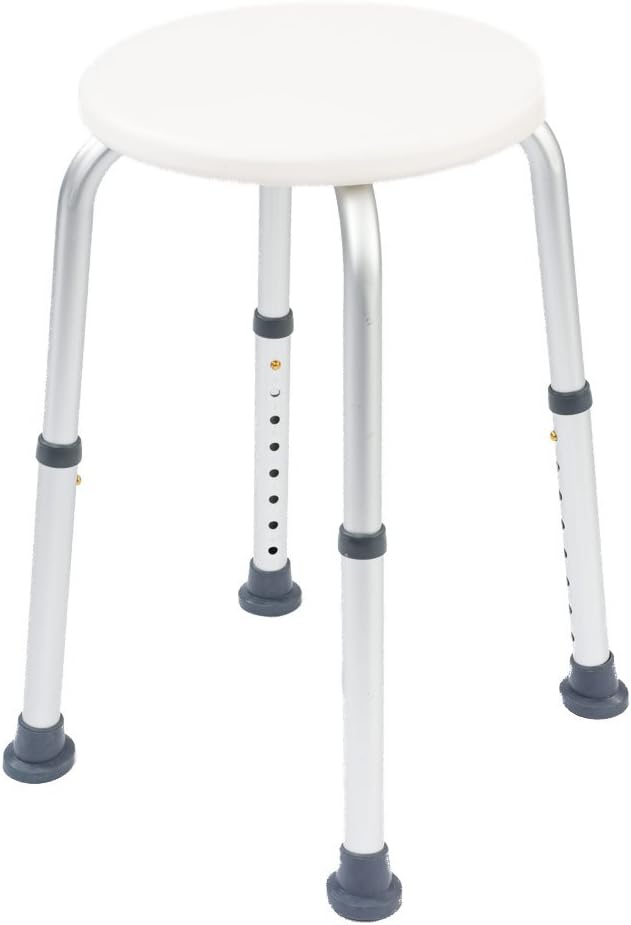
A simple stool with three or four legs and no back or arms. It has the smallest footprint of any option, which makes it the best fit for a tight shower cubicle where a chair with arms wouldn’t leave enough room to move. It suits someone who’s fairly steady on their feet but wants somewhere to sit rather than stand for the whole shower. Some models have a small handle cut into the seat for carrying and repositioning; a few include a lower shelf underneath for toiletries.
Shower chair
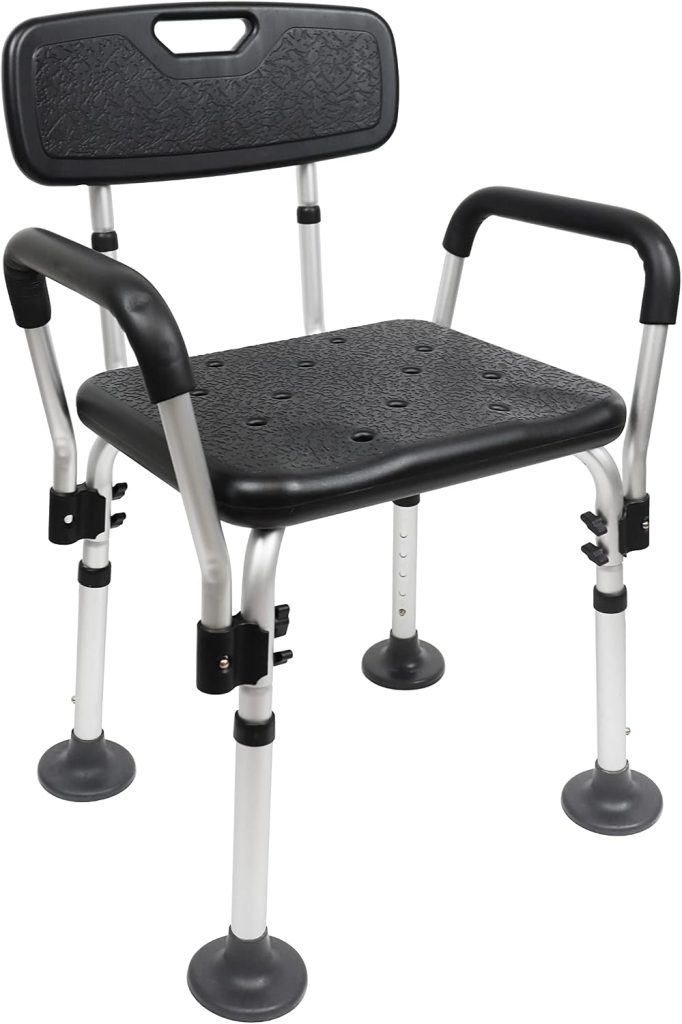
Adds a backrest and, on most models, armrests to a stool base. The arms give something solid to push against when standing back up, and the backrest supports anyone who tires or loses balance easily partway through washing. This is what most people mean by a shower chair for the elderly or a disabled shower chair, and for most buyers it’s the right starting point, since it covers both a stool’s function and extra support if it’s ever needed.
Wall-mounted folding shower seat
Fixes permanently to the shower wall and folds flat against it when not in use, so it doesn’t take up floor space or need to be lifted in and out of the cubicle between showers.
This suits a shower used by more than one person in the household, where only some users need the seat, or a smaller cubicle where a freestanding chair would block the drain or the door. It needs a solid wall for fixing, timber stud or solid masonry behind the tiles rather than thin plasterboard alone, since the seat takes the user’s full weight through two or three fixing points.
Bath seat or bath board
Sits across or inside the bathtub rather than in a shower cubicle, for anyone with a bath rather than a separate shower, or a shower-over-bath setup. A bath board spans the width of the tub near one end, giving a dry place to sit while lowering into the water, or simply a seated washing position without getting fully in. This is a genuinely different product from a shower chair, not a variation of it, since it has to bridge or fit the specific dimensions of a bathtub rather than stand on a flat shower floor.
Transfer bench
A longer bench that straddles the wall of the bath, with legs both inside and outside the tub. The user sits on the outer end, then slides sideways along the bench into the bath without ever having to step over the tub wall or take weight through the legs during the transfer. This is the option for anyone who struggles specifically with the step over the bath edge, rather than with standing or balance once inside, and it’s a common recommendation after hip or knee surgery.
Materials and Build
Most shower and bath seats are made from either aluminium or plastic, occasionally powder-coated steel.
Aluminium frames are lighter, won’t rust, and are the standard choice for anything that needs to be moved, folded, or lifted regularly. Plastic seats are usually cheaper and fully waterproof through and through, but tend to have lower weight capacities than aluminium-framed models. Steel-framed seats are heavier and less common now, generally only seen on older or heavy-duty designs, since aluminium does the same job at a lower weight.
Seat surfaces are almost always a textured or slatted plastic rather than fabric, both for grip when wet and because fabric doesn’t hold up to constant water exposure.
Features Worth Checking Before You Buy
Drainage holes or slats in the seat. Water needs somewhere to go rather than pooling under the user, and a solid seat with no drainage will feel unpleasant and take longer to dry between uses.
Feet: suction cups vs rubber ferrules. Suction feet grip a completely flat, smooth shower tray well but can release unexpectedly on textured or slightly uneven tiles. Standard rubber ferrules, the same non-slip tips used on walking frames, are more dependable across different floor types but rely on the user’s own weight to stay in place rather than actively gripping the surface.
Height adjustability. Legs that adjust in small increments let you match the seat height to the user rather than a one-size-fits-all setting, which matters more for a shower chair than a wall-mounted seat, since the wall-mounted version is fixed once during installation.
Weight capacity. This varies more than almost any other spec between models, from around 100kg on a basic plastic stool up to 200kg or more on a reinforced bariatric shower chair. Always check the figure listed on the specific product rather than assuming, since it isn’t consistent across a brand’s range.
Backrest and armrest padding. Bare plastic is fine for a short shower but can feel hard and cold for anyone using the seat daily or for longer periods; a small number of models offer a padded or cushioned version.
How to Measure Before You Buy
For a freestanding stool or chair, measure the shower cubicle’s internal floor space with the door closed, then subtract enough clearance for the door to swing or slide without catching the seat. For a wall-mounted seat, measure the wall’s usable width between any fixtures (taps, shower rail, corner) at the height you plan to fix it, and check what’s directly behind the tiles at that spot, since that determines whether it can be fixed without extra reinforcement.
For a bath board or transfer bench, measure the external width of the bath, most are a standard size, but older or non-standard baths can be narrower or wider than typical products are designed for.
Choosing the Right Option
Fairly steady, just wants to sit rather than stand: a shower stool, the smallest and most affordable option.
Needs support standing up, or tires during a shower: a shower chair with arms and a backrest.
Small bathroom, or the seat needs to be out of the way between uses: a wall-mounted folding seat, fixed once and folded away rather than lifted in and out.
Bath rather than a separate shower cubicle: a bath seat or bath board rather than a shower chair.
Struggles specifically with stepping over the bath edge: a transfer bench, which removes the need to step over the wall of the tub at all.
What Shower Seats Cost in Ireland
Prices vary by type and features. As a general guide across the Irish market:
- Basic shower stool: roughly €25 to €45
- Folding shower chair with arms and backrest: roughly €40 to €90
- Wall-mounted folding shower seat: roughly €50 to €110, plus fitting if you’re not doing it yourself
- Bath seat or bath board: roughly €30 to €80
- Transfer bench: roughly €70 to €150
Height-adjustable legs, a padded seat, and a higher weight capacity all push a model toward the top of its range.
Fitting a Wall-Mounted Seat
Fixing into solid masonry or a timber stud behind the tiles can often be done with a drill, suitable wall plugs, and about half an hour, well within reach for anyone comfortable with basic DIY. The harder case is a stud partition wall with no solid backing behind the tiles at the fixing points, where the wall alone won’t safely bear the load and a plumber or fitter needs to add a mounting plate or noggin behind the tile first.
If there’s any doubt about what’s behind the wall at the height you need, it’s worth checking before ordering rather than after.
Cleaning and Hygiene
Most shower and bath seats can be wiped down with a standard bathroom cleaner or diluted disinfectant; textured plastic surfaces resist mould better than fabric ever would but still benefit from a wipe after each use if more than one person shares the shower. Many retailers don’t accept returns or exchanges on shower and bathing aids once used, for hygiene reasons, so it’s worth being confident about the type and size before ordering rather than planning to try one and swap it.
Grants and Financial Help in Ireland
If you have a medical card, a public occupational therapist can assess your needs and may be able to supply a shower seat or wall-mounted seat directly through the HSE, at no cost. This is particularly worth pursuing for a wall-mounted seat, since the OT visit also confirms the wall is suitable for fixing before any work is done.
For anyone paying privately, the Mobility Aids Grant Scheme covers smaller bathroom changes, including shower seating, with a maximum grant of €8,000, means-tested and administered through your local authority. If shower seating is part of a larger bathroom adaptation, such as converting a bath to a level-access shower, the Housing Adaptation Grant for People with a Disability covers that larger scope of work, up to €40,000 depending on household income.
Shower Seats
Frequently Asked Questions
Is a shower chair the same as a bath seat?
No. A shower chair stands on the floor of a shower cubicle. A bath seat or bath board sits across or inside the bathtub. They’re built for different fixtures and aren’t interchangeable.
What’s the difference between a bath board and a transfer bench?
A bath board sits fully across the top of the tub, giving a seated position for washing. A transfer bench extends beyond the tub wall on legs, letting the user sit down outside the bath first, then slide across into it, which removes the need to step over the tub edge entirely.
Can shower seats be used outdoors or with a hose?
Standard shower seats are built for indoor bathroom use. If outdoor use is needed, for example for a garden shower or hosing down after a wheelchair transfer, check the specific product for a stated outdoor or all-weather rating rather than assuming.
Will a shower chair fit in a small shower cubicle?
Measure the internal floor space with the door closed and shut before buying, since a chair with arms takes up meaningfully more room than a stool, and a door that slides rather than swings changes how much clearance is actually needed.
Do I need planning permission or building notice to fit a wall-mounted seat in Ireland?
No. Fitting a wall-mounted shower seat is a minor internal fixing, not structural work, so it doesn’t require planning permission or a building notice.