
Wheelchair ramps in Ireland for steps, doorways and kerbs: threshold, kerb, folding and channel ramps compared, with a length guide and grant help.
Wheelchair Ramps to Compare
Today’s prices on threshold, folding and portable wheelchair ramps.
A single step at the front door, a raised threshold or a kerb can stop a wheelchair, a rollator or a mobility scooter. The right ramp depends on how high the rise is, how much space you have, and whether the ramp needs to stay in place or travel with you.
This guide explains the types of wheelchair ramp, how long a ramp needs to be for your step, and when a permanent ramp is worth paying for, including the council grants that can cover it.
Wheelchair ramps compared
| Type | Key detail | Price | ||
|---|---|---|---|---|
|
Cnwinu rubber threshold Doorways | Threshold ramp | 2.5 cm rise, cuttable | €24.70 | View on Amazon |
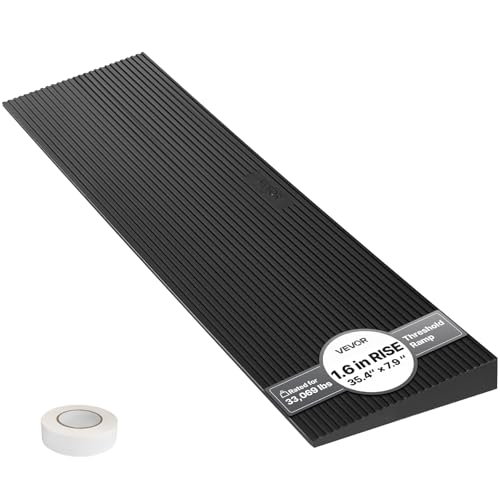
VEVOR solid rubber Doorways | Threshold ramp | 4 cm rise, 90 cm wide | €44.00 | View on Amazon |
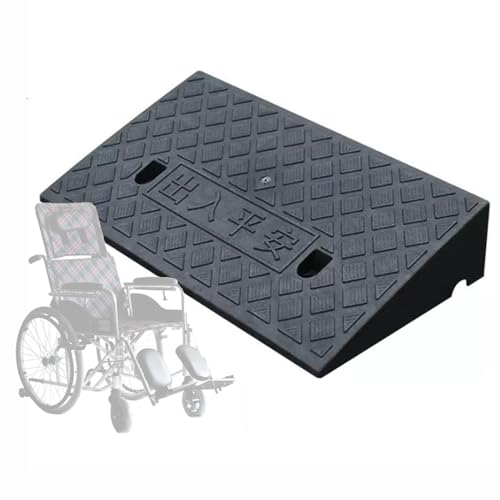
DAQXYH rise ramp Kerbs | Kerb ramp | Sizes from 1" to 8" rise | €30.89 | View on Amazon |
|
XARILK bridge ramp Raised sills | Bridge ramp | 4 cm high, 2 pack | €95.96 | View on Amazon |
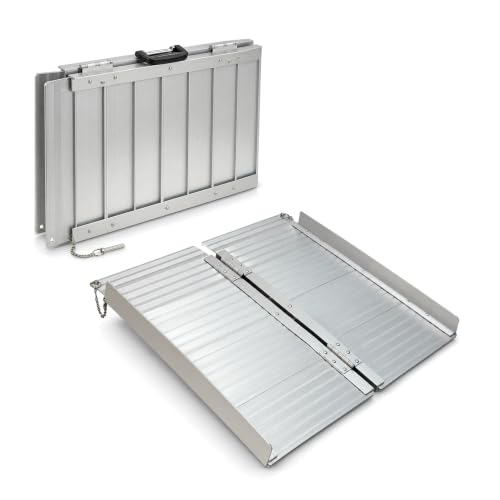
Aidapt 2 ft folding Small steps | Folding ramp | 60 cm, aluminium | €95.23 | View on Amazon |
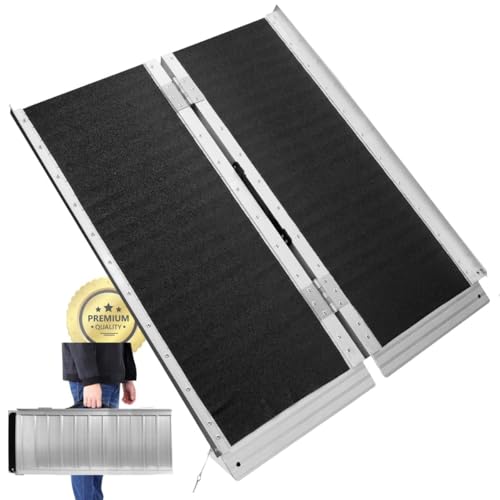
OrtoPrime folding ramp Steps | Folding ramp | 270 kg limit | €117.00 | View on Amazon |
|
The Ramp People 1.2 m Steps to 200 mm | Folding ramp | 8.8 kg, 300 kg limit | €214.92 | View on Amazon |
|
Telescopic channel ramps Steps and vehicles | Channel ramps | 90 to 154 cm | €129.85 | View on Amazon |
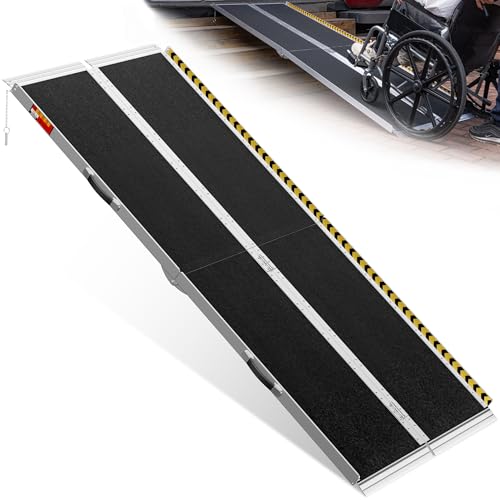
PURFINO 213 cm ramp Two steps | Folding ramp | Steps of 18 to 53 cm | €287.34 | View on Amazon |
Table of Contents
Types of Wheelchair Ramp
Threshold ramps
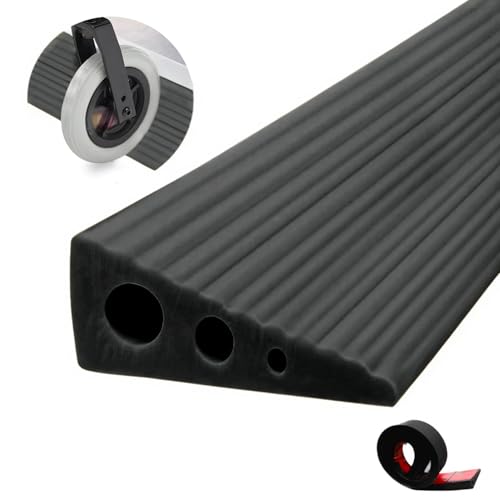
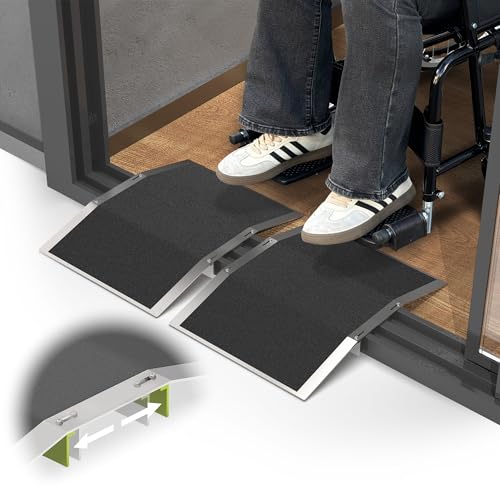
Threshold ramps are short, low ramps that smooth out a raised door sill or a small lip between rooms, usually up to about 5 cm. Rubber ones lie flat on the floor and can often be cut to width. Aluminium bridge ramps sit over a sill with a ramp on each side. Threshold ramps can stay in place permanently and suit wheelchairs, rollators and walking frames.
Kerb ramps
Kerb ramps are wedge-shaped blocks for a single kerb or a garage step. They are heavy and stay where they are put, and they come in set heights.
Folding ramps
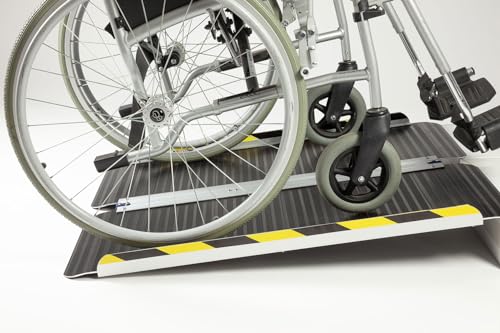
Folding or suitcase ramps are a single wide platform that folds in half and has a carry handle. They cover one step, a front doorstep or a kerb, usually up to about 20 cm, and they are the simplest portable ramp to use because the full width is ramp.
Channel ramps
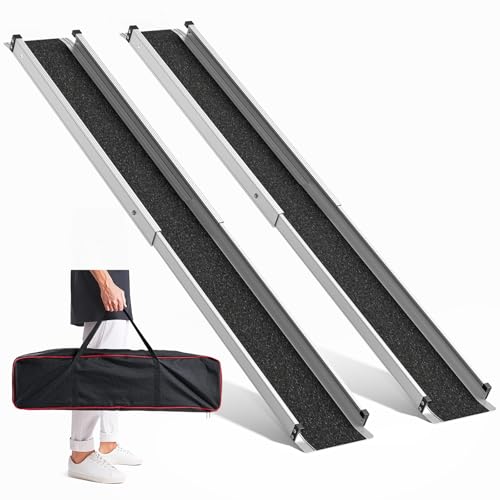
Channel ramps are a pair of narrow tracks, one for each side of the wheelchair. They are lighter and often telescopic, so they pack small and reach further. The downside is that both tracks have to be lined up with the wheels, so they suit a helper pushing the chair rather than someone wheeling themselves.
Permanent and modular ramps
For a home where someone uses a wheelchair every day, a permanent ramp built in concrete or a modular aluminium system with handrails is the long-term answer. These are fitted by a contractor and can be paid for by a council grant (see below).
How Long Should a Wheelchair Ramp Be?
Measure the rise: the height from the ground to the top of the step or sill. The ramp length then depends on the gradient, which is the rise compared with the length. A 1:12 gradient means 12 cm of ramp for every 1 cm of rise.
For permanent ramps, Irish building guidance (Part M of the Building Regulations) treats 1:20 as the preferred gradient and allows a steeper 1:12 only for short ramps of up to about 2 metres. Gentler is always better for someone wheeling themselves.
For portable ramps, there is rarely room for those gradients. UK ramp makers suggest no steeper than 1:6 when a helper is pushing a manual wheelchair, and 1:8 for someone wheeling themselves, a powered wheelchair or a mobility scooter. Always check what your chair or scooter's manual says it can climb.
Ramp length for common rises:
- 5 cm rise: 30 cm at 1:6, 40 cm at 1:8, 60 cm at 1:12
- 10 cm rise: 60 cm at 1:6, 80 cm at 1:8, 1.2 m at 1:12
- 15 cm rise: 90 cm at 1:6, 1.2 m at 1:8, 1.8 m at 1:12
- 20 cm rise: 1.2 m at 1:6, 1.6 m at 1:8, 2.4 m at 1:12
- 30 cm rise (about two steps): 1.8 m at 1:6, 2.4 m at 1:8, 3.6 m at 1:12
If you are between sizes, choose the longer ramp.
Permanent Ramps and Council Grants
A permanent ramp to the front or back door can be funded by your local council. The Mobility Aids Grant pays up to €8,000 for works such as ramps and grab rails for households with an income under €37,500. The Housing Adaptation Grant for People with a Disability pays up to €40,000 for bigger adaptations. The council must approve the grant before any work starts, and it may ask for an occupational therapist's report. Our guide to mobility aids grants in Ireland has the full rates and income limits.
A permanent ramp at the front of a house can change how it looks from the road, so check with your council's planning section whether you need planning permission before work begins.
Using a Ramp Safely
- Check the weight limit covers the user, the wheelchair or scooter, and a helper if they walk on the ramp.
- Make sure the top edge sits flat on the step with no gap or lip, and that the bottom rests on firm, level ground.
- Use a non-slip surface. Irish weather means ramps are wet much of the year, so pick one with a grip coating and keep it free of moss and leaves.
- Go up forwards and come down backwards when a helper is pushing a manual wheelchair, so the helper stays below the chair.
- Raised edges and handrails matter on longer ramps, to stop a wheel running off the side.
Ramps are also used to load a mobility scooter into a car or van. See our guide to mobility scooters in Ireland and our wheelchair guide.
Every threshold, folding and channel ramp we list, with today’s prices.
Wheelchair Ramp Questions
What length ramp do I need for one step?
Measure the height of the step. A typical step of about 15 to 18 cm needs a ramp of at least 90 cm to 1.1 m if a helper pushes a manual wheelchair, and around 1.2 to 1.5 m for a powered chair, a scooter or someone wheeling themselves.
Can I get a grant for a wheelchair ramp in Ireland?
Yes. A permanent ramp can be covered by the council’s Mobility Aids Grant, up to €8,000, or the Housing Adaptation Grant for People with a Disability. Approval must come before work starts.
Are threshold ramps suitable for mobility scooters?
Most are, as long as the weight limit covers the scooter and the user. Check the scooter’s ground clearance on higher sills, as a steep bridge ramp can catch the underside.
Do I need planning permission for a wheelchair ramp?
Portable ramps do not. For a permanent ramp at the front of a house, check with your council’s planning section before work starts.